

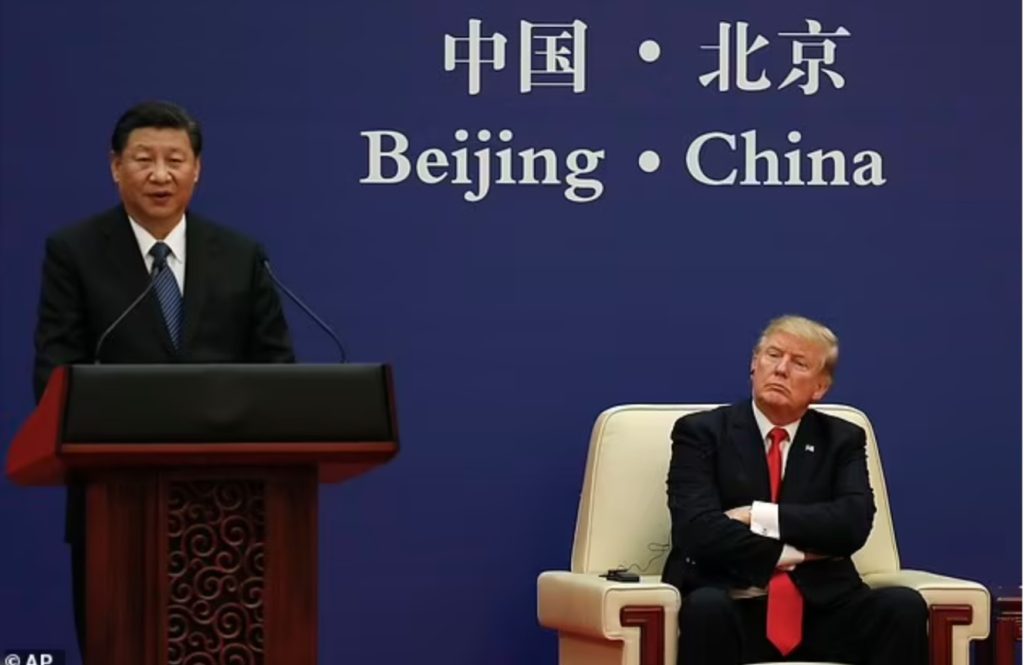
China has responded to President Donald Trump’s tariffs by imposing its own trade measures against the U.S., escalating tensions in an ongoing trade war.
According to China’s Finance Ministry, the new tariffs include a 15% duty on specific types of coal and liquefied natural gas, as well as a 10% tariff on crude oil, agricultural machinery, large-engine vehicles, and pickup trucks.
Additionally, China’s Commerce Ministry and Customs Administration announced new export controls on tungsten, tellurium, ruthenium, molybdenum, and related products, citing national security concerns.
Meanwhile, China’s State Administration for Market Regulation has launched an antitrust investigation into Google, though details regarding the probe remain unclear.
The tariffs would go into effect next Monday.
This comes after Trump implemented his 10 percent tariffs on all Chinese imports to the United States.
A White House spokesperson said Trump would not be speaking with Chinese President Xi Jinping until later in the week.
During his first term in 2018, Trump initiated a brutal two-year trade war with China over its massive U.S. trade surplus, with tit-for-tat tariffs on hundreds of billions of dollars worth of goods, upending global supply chains and damaging the world economy.
To end that trade war, China agreed in 2020 to spend an extra $200billion-a-year on U.S. goods – but that plan was derailed by the COVID pandemic.
Its annual trade deficit then widened to $361billion, according to Chinese customs data released last month.
The trade war is in the early stages so the likelihood of further tariffs is high,’ Oxford Economics said in a note as it downgraded its China economic growth forecast.
Trump has now warned he might increase tariffs on China further unless Beijing stemmed the flow of fentanyl, a deadly opioid, into the United States.
‘China hopefully is going to stop sending us fentanyl, and if they’re not, the tariffs are going to go substantially higher,’ he said on Monday.
